

Brandt 2013 - review of transdisciplinary research in sustainability science
2025-11-24 Subject: Social SciencesThis article reviews peer‑reviewed transdisciplinary research in sustainability science using mixed quantitative and qualitative bibliometric analysis. It assesses growth, impact, methods, process phases, knowledge types, and practitioner involvement. Findings show rising output but fragmented terminology, lack of shared frameworks and platforms, broad yet incoherent method use, geographic concentration in Europe/North America, low empowerment of practitioners, and modest journal impact. The authors recommend clearer framing, common glossary, and a broad suite of appropriate methods, alongside deeper practitioner engagement to advance sustainable transitions.
Ch5 - Arts-Based Research Practices
2025-11-24 Subject: ArtsThis chapter introduces arts-based research (ABR) as a transdisciplinary, public-facing methodology that adapts creative arts—especially theatre—to social research across design, data collection, analysis, and representation. It highlights playbuilding, ethnodrama, and health theatre, emphasizing iterative, collaborative, and responsive processes that engage diverse publics, surface complex feelings and ethics, and democratize meaning-making. Examples include bullying and healthcare issues, with guidance on aesthetics, ethics, and dissemination. The chapter argues ABR can inform policy by educating, challenging stereotypes, and involving stakeholders in decision-making.
Proposal for the Service Design of a Waste Sorting
2025-11-24 Subject: Urban StudiesThis paper applies service design to improve waste sorting in Shanghai’s public residential districts. Using mixed methods—field audits, a 407-respondent survey, user personas and journey maps, and case studies from South Korea and Japan—it identifies gaps between policy and residents’ needs (unclear labels, inconvenient placement, overflows). It proposes an intelligent, modular bin system with IoT sensors, RFID/QR access, image recognition, real-time capacity alerts, integrated handwashing, and a points-based rewards app. A service blueprint targets touchpoints to boost usability, participation, and compliance.
Lang et al 2012 - Transdisciplinary research in sustainability science
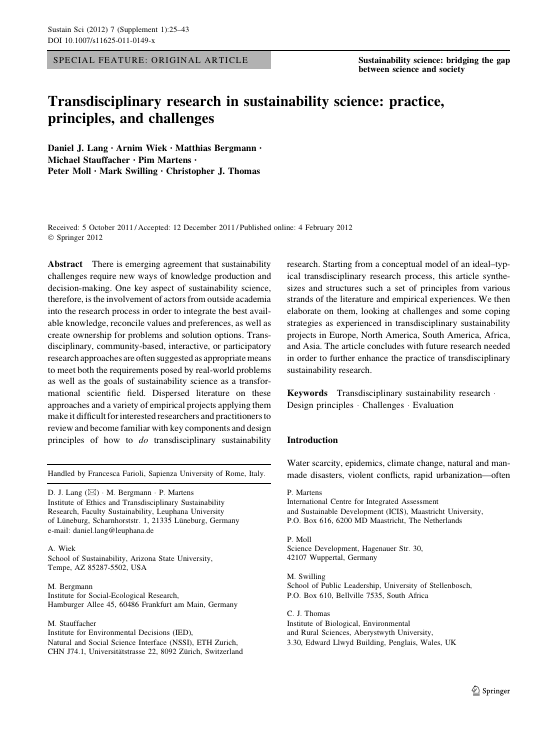
2025-11-21 Subject: SciencesThis paper compiles practice-oriented design principles for transdisciplinary sustainability research and anchors them in an ideal–typical three-phase process. Drawing on a dispersed body of literature and cases from Europe, North America, South America, Africa, and Asia, it synthesizes guidance on collaborative problem framing, the co-production of solution-oriented and transferable knowledge, and the (re-)integration of this knowledge into scientific and societal practice. It also identifies common challenges and coping strategies, and concludes with future research needs to enhance evidence, coordination, and capacity for impactful science–society collaboration.
Ch3 - Research Design
2025-11-21 Subject: Social SciencesThis chapter presents transdisciplinary research design as issue- or problem-centered, holistic, and responsive. It outlines three stages—planning, data collection, and analysis/interpretation/representation—guided by iterative, reflexive, and recursive methodologies. It emphasizes broad preparation across disciplines, mixed/multi-method and hybrid designs (e.g., social network analysis, extended case, qualitative case-control, photovoice), and collaborative division of labor. Examples from integrative health care, architecture, and cross-cultural projects illustrate defining concepts and building intersubjectivity. Finally, it stresses significant, ethical, real-world purposes and accessible dissemination beyond academic journals.
Ch4 - Community-Based Research Practices
2025-11-21 Subject: Social SciencesThis chapter outlines community-based research (CBR) as collaborative, problem-centered, and transdisciplinary, emphasizing social action and social justice. It details design principles—deep collaboration, cultural sensitivity, recruitment and retention, trust-building, valuing multiple knowledges, flexibility and innovation, and accessible representation and dissemination—with policy implications. Illustrative cases include health disparities projects (TBCCN colorectal and prostate cancer, barbershop outreach, GIS mapping), Chicago fair housing research, and cross-cultural/transnational studies (INCLEN obesity, ISPOT), highlighting challenges of ethics, language, funding, and coordination.
BAScT|Students Explore Macau’s Sustainable Solutions
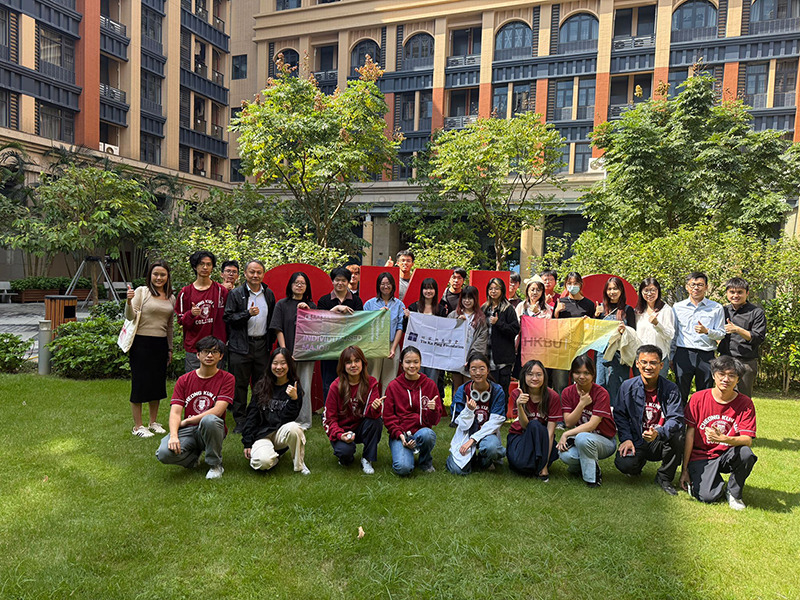
2025-11-19 Subject: ArtsOn Oct 24-25, our BAScT Year 2 students from the ITS 2018 Transdisciplinary Problem Solving I course embarked on an amazing study tour in Macau! 🌏 To explore how Macau tackles real-world challenges with sustainable methods and to witness the incredible fusion of art, technology, and Chinese culture. 🧠 AI x Sustainability: Students kicked things off at the UNU Macau AI Conference 2025, diving into keynote speeches and parallel sessions. It was a fantastic opportunity to learn how AI can drive sustainable development and to brainstorm new ideas for their individual projects! 🏨 Behind the Scenes of Green Hospitality: We got an exclusive look behind the scenes at City of Dreams Macau! Led by the Property Department Manager, students learned firsthand about sustainable solutions being implemented in the hotel industry. 🤝 A Spark of Collaboration: At the University of Macau, students had a wonderful exchange with over 10 students from Cheong Kun Lun College. They shared their inspiring SDG events on campus, while our BAScT Programme Director, Prof. Nick ZHANG, introduced the programme features and outcomes. Our student, Tim, also shared his valuable experience leading the “Eye Mirror” project. Students exchanged contacts and were excited about potential future collaborations for competitions! 🎭 A Feast for the Senses: The “MGM 2049” show at the MGM Theater was absolutely eye opening! It was a stunning combination of cutting-edge technology and the essence of thousands year old Chinese culture, completely redefining students’ perception of intangible cultural heritage art. This tour not only broadened our students‘ horizons but also ignited their passion for solving real-world problems with a transdisciplinary approach!
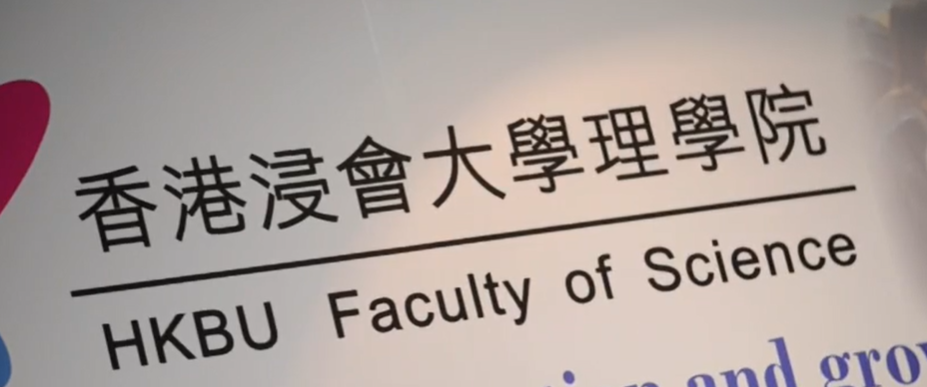
Introducing HKBU Faculty of Science
2025-11-19 Subject: SciencesThe Faculty of Science strives to play a key leading and innovative role in science and technological education by delivering excellence in teaching and learning, conducting cutting-edge academic research and proactively contributing to the advancement of society. The video highlighted our vision & mission, commitment and achievement for the betterment of society with the illustration of our dedication in providing quality teaching, cutting edge inter-disciplinary academic research, devotion to the community services, and closeness teacher-student relationship. http://www.sci.hkbu.edu.hk/
[HKBU] BSocSc/BSc (Hons) in Innovation in Health and Social Well-Being JS2940
2025-11-19 Subject: Health Informatics, Social SciencesThis transdisciplinary programme offered by Hong Kong Baptist University will equip students with the necessary skill-set to apply and integrate technologies with their domain knowledge in health and wellness. Graduates will be technologically competent, entrepreneurial and adventurous. They will be able to identify problems and use cutting-edge health and social technologies to meet the emerging needs in Hong Kong and beyond. Get to know more the programme via https://transdisciplinary.hkbu.edu.hk/hswb/
AI and Data Analytics for Health and Social Innovation Exhibition
2025-11-19 Subject: Health Informatics, Social SciencesWith the theme of "AI and Data Analytics for Health and Social Innovation", the exhibition spotlights the 7 projects by students of COMP2036 that blend technology with care, aiming to improve the quality of life through smart solutions. Focusing on different topics including mental health, exercise and sleep problems, the students, in which most of them are from Bachelor of Social Sciences (Hons) / Bachelor of Science (Hons) in Innovation in Health and Social Well-Being, prepared their social innovation projects to bring awareness or help the people in need and share with participants.

Starting from a conceptual model of an ideal–typical transdisciplinary research process, this article synthesizes and structures such a set of principles from various strands of the literature and empirical experiences.
Language of Importance of this Researchteacher's tips: Highlights bridging science and society
Template: Research paper discussion
Where is this sentence from: Sciences
As a problem- and solution-oriented field, sustainability science is inter alia inspired by concepts of post-normal, mode-2, triple helix, and other science paradigms (Funtowicz and Ravetz 1993; Gibbons et al. 1994; Etzkowitz and Leydesdorff 2000) that employ corresponding research practices, such as transdisciplinary, community-based, interactive, or participatory approaches (Kasemir et al. 2003; Savan and Sider 2003; Becker 2006; Robinson and Tansey 2006; Hirsch Hadorn et al. 2006; Jahn 2008; Scholz et al. 2006; Scholz 2011).
Language of Reasoningteacher's tips: Establishes rationale and gaps
Template: Research paper discussion
Where is this sentence from: Sciences
According to this model (Fig. 1), a transdisciplinary research process is conceptualized as a sequence of three phases, including: collaboratively framing the problem and building a collaborative research team (Phase A); co-producing solution-oriented and transferable knowledge through collaborative research (Phase B); and (re-)integrating and applying the produced knowledge in both scientific and societal practice (Phase C).
Language of Importance of this Researchteacher's tips: Clarifies the process structure
Template: Research paper discussion
Where is this sentence from: Sciences
Identify scientists from relevant disciplines/scientific fields and “real-world actors” who have experience, expertise, or any other relevant “stake” in the problem constellation pre-identified for the research project (Pohl and Hirsch Hadorn 2007).
Language of Reasoningteacher's tips: Ensures inclusive and workable start
Template: Research paper discussion
Where is this sentence from: Sciences
Assign in each research effort appropriate roles and responsibilities for scientists and practitioners in a transparent process, accounting for inertia, reluctance, and structural obstacles (Maasen and Lieven 2006; Wiek 2007).
Language of Reasoningteacher's tips: Balances rigor and relevance
Template: Research paper discussion
Where is this sentence from: Sciences
Provide the scientific actors and the practice partners with appropriate products (cf. Defila et al. 2006) that present and “translate” the results of the project in a way that the actors can make use of—as a contribution to real-world problem-solving/transformation or to scientific progress/innovation (Pohl and Hirsch Hadorn 2007).
Language of Importance of this Researchteacher's tips: Emphasizes uptake and assessment
Template: Research paper discussion
Where is this sentence from: Sciences

Since 2019, when Shanghai initiated pilot waste sorting programs in some public residential districts, most waste is still 'mixed and unsorted', with low compliance rates for proper classification. The fundamental issue of sorting waste at the source remains unresolved. Problems such as incomplete regulations, lack of public awareness, and low efficiency in processing continue to persist.<br><br> 自 2019 年上海在部分居住小區推行垃圾分類試點計劃以來,大部分垃圾依然是『混合未分類』,正確分類的遵從率偏低。源頭分類的根本問題仍未解決。法規不完善、公眾意識不足,以及處理效率低等問題依然持續存在。
Language of Framingteacher's tips: Why transdisciplinary framing? The writers frame the problem as a stubborn failure. By citing "regulations" (policy/law), "public awareness" (sociology/psychology), and "processing efficiency" (engineering/logistics) as simultaneous causes, they demonstrate that the issue cannot be solved by one discipline alone. The phrases "remains unresolved" and "continue to persist" imply that previous, isolated attempts have failed
Template: Since [Year/Timeframe], when [Subject] initiated [Specific Program/Action], most [Target] is still [Negative Outcome], with [Metric of Failure] (e.g., adoption levels, frequency of something). Problems such as [Noun Phrase 1], [Noun Phrase 2], and [Noun Phrase 3] continue to persist.
Where is this sentence from: Health Informatics